
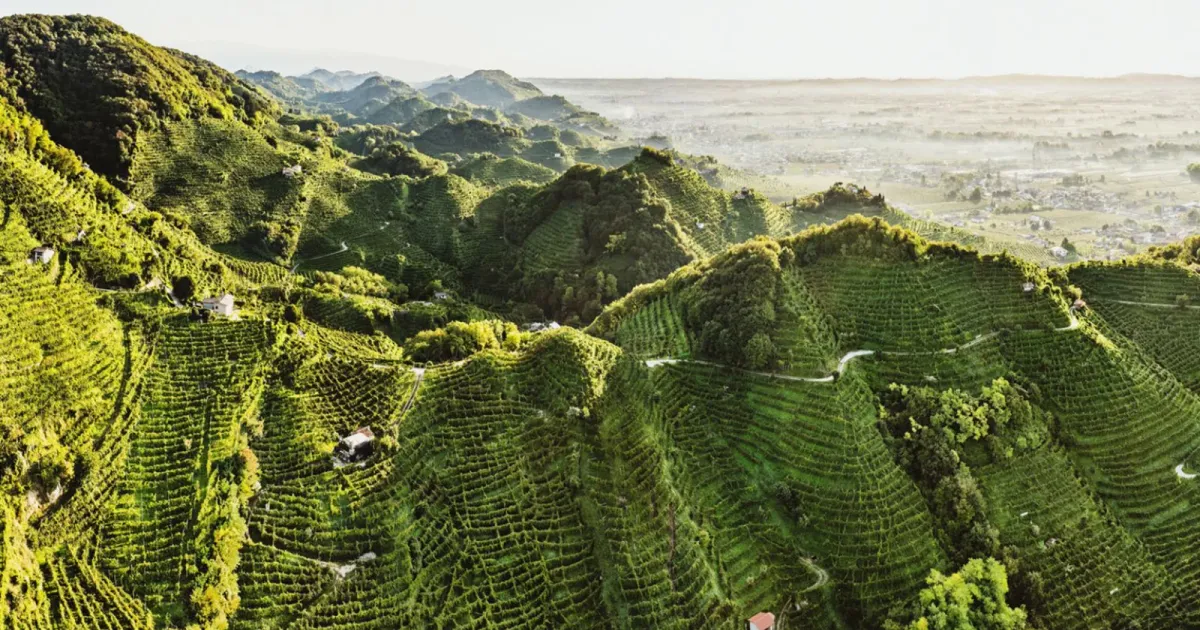
Where Prosecco gets specific
Notes from a 2026 industry tasting in New York.
Prosecco is often understood as a style: fresh, fruit-led sparkling wine, generally made in tank (The Charmat method). At a recent industry tasting at Portale in New York, sommelier Taylor Parsons and Conegliano Valdobbiadene Director Diego Tomasi asked us to consider a different question: what happens when we think of Prosecco as a place, rather than a price or a style? 1
From Prosecco to a particular hillside
The seminar started off with a study of geography. The broad Prosecco DOC covers a large production area across northeastern Italy, with production generally discussed in terms of scale and consistency. Conegliano Valdobbiadene Prosecco Superiore DOCG comes from a much smaller, hilly area in Veneto. For context, the Prosecco DOC consortium reported about 667 million bottles (including rosé) in 2025, versus approximately 98 million for Conegliano Valdobbiadene DOCG.
Producers are increasingly emphasizing place rather than simply style or sweetness. Historically, Prosecco was often differentiated by sweetness level. Within the DOCG, the emphasis is shifting toward progressively more specific origins: from the denomination, to a named area, and ultimately to an individual vineyard or parcel.
The DOCG covers 15 communes. Rive identifies one of 43 named local areas, with hand-harvested grapes, lower permitted yields, and a required vintage. Superiore di Cartizze refers to a particularly small, historically recognized subzone near Valdobbiadene. These increasingly specific designations give consumers information about origin, not just the style of sparkling wine.
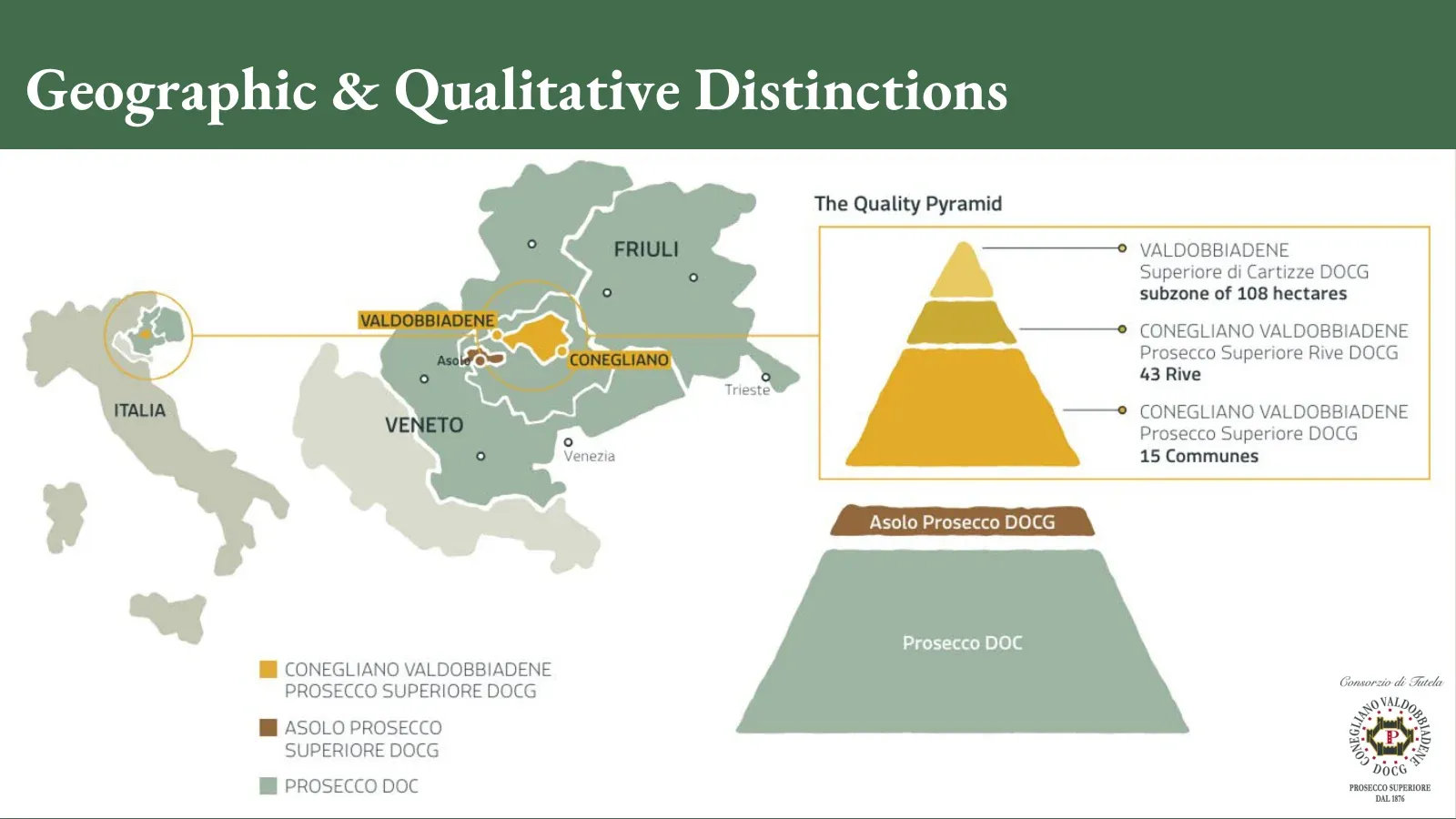 Figure: Slide 13 — geographical denominations, from Prosecco DOC to Conegliano Valdobbiadene and its named areas.
I would read this hierarchy primarily as a progression in geographical specificity, not a guaranteed ranking of quality. A more precise origin gives us a better starting point for understanding a wine, but does not automatically make it better.
Why those hills matter
The terrain makes this a different proposition from vineyards on flatter land. Steep slopes, small parcels and narrow grassy earth terraces, known as ciglioni, make mechanization difficult. These terraces help stabilize the slopes and manage erosion; they are also part of the historic vineyard landscape recognized by UNESCO in 2019.
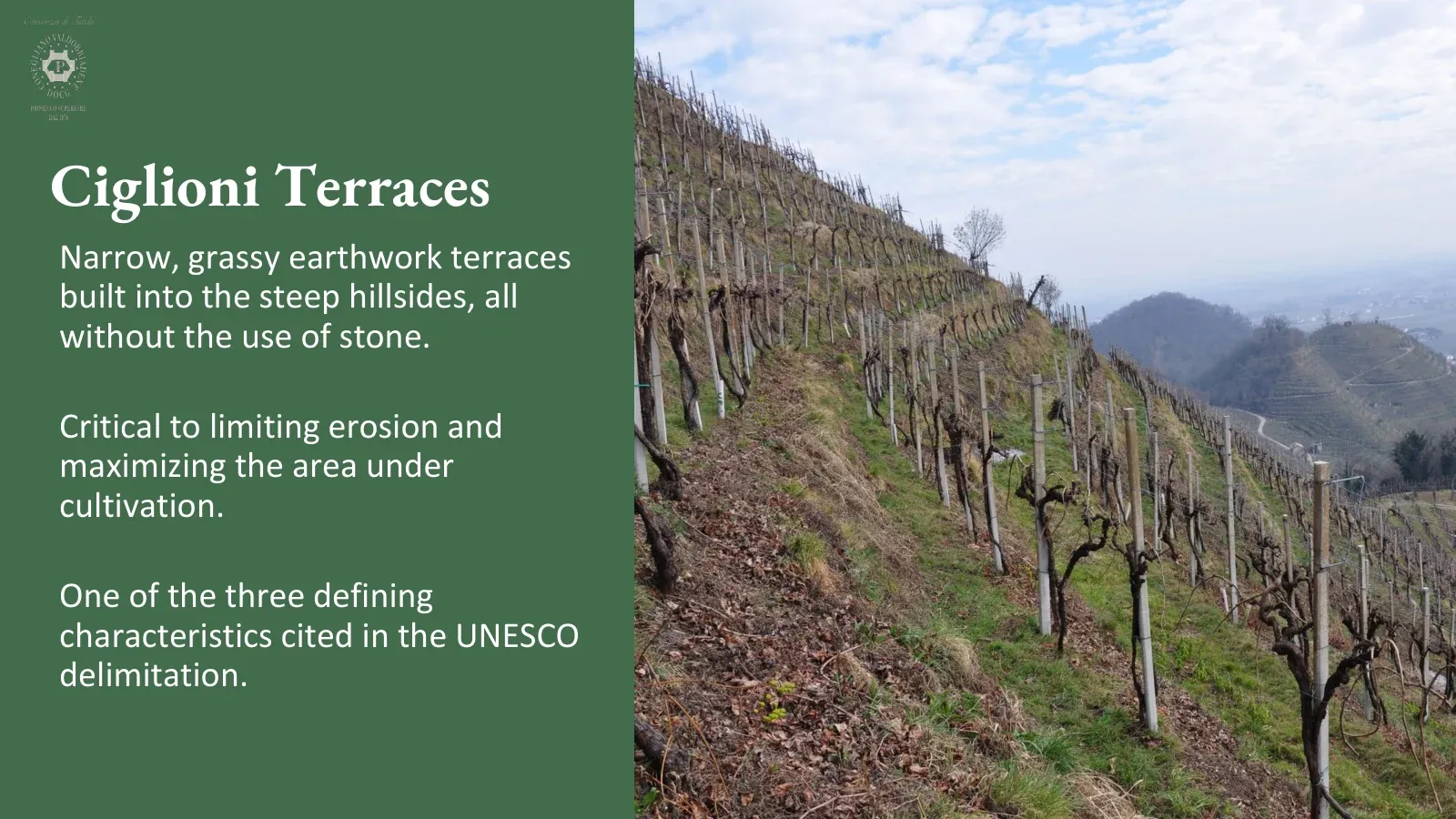 Figure: Slide 29 — the narrow grassy ciglioni terraces that shape the vineyards.
The seminar emphasized the labor and economics involved. Farming some of these hillsides can demand several times the work required in easily mechanized vineyards. Land was also described as expensive, while average vineyard holdings were said to be less than roughly one hectare per grower. Interestingly, three cooperatives were reported to account for around 40% of DOCG production. Vineyard ownership can be highly fragmented even where winemaking is relatively concentrated.
The geography matters for the Glera grape, too. This variety needs adequate water and retains considerable natural acidity as it ripens. Exposure, elevation, rainfall and soils vary across the hills, influencing growing conditions and potentially the resulting wines.
Three zones, many expressions
Parsons offered a useful way to organize the tasting: Western and Northern Slopes, Central Hills, and Southern Curve. These are broad geographical groupings for understanding differences within the DOCG, rather than additional official appellations; Parsons emphasised these were his own way of thinking about the regions.
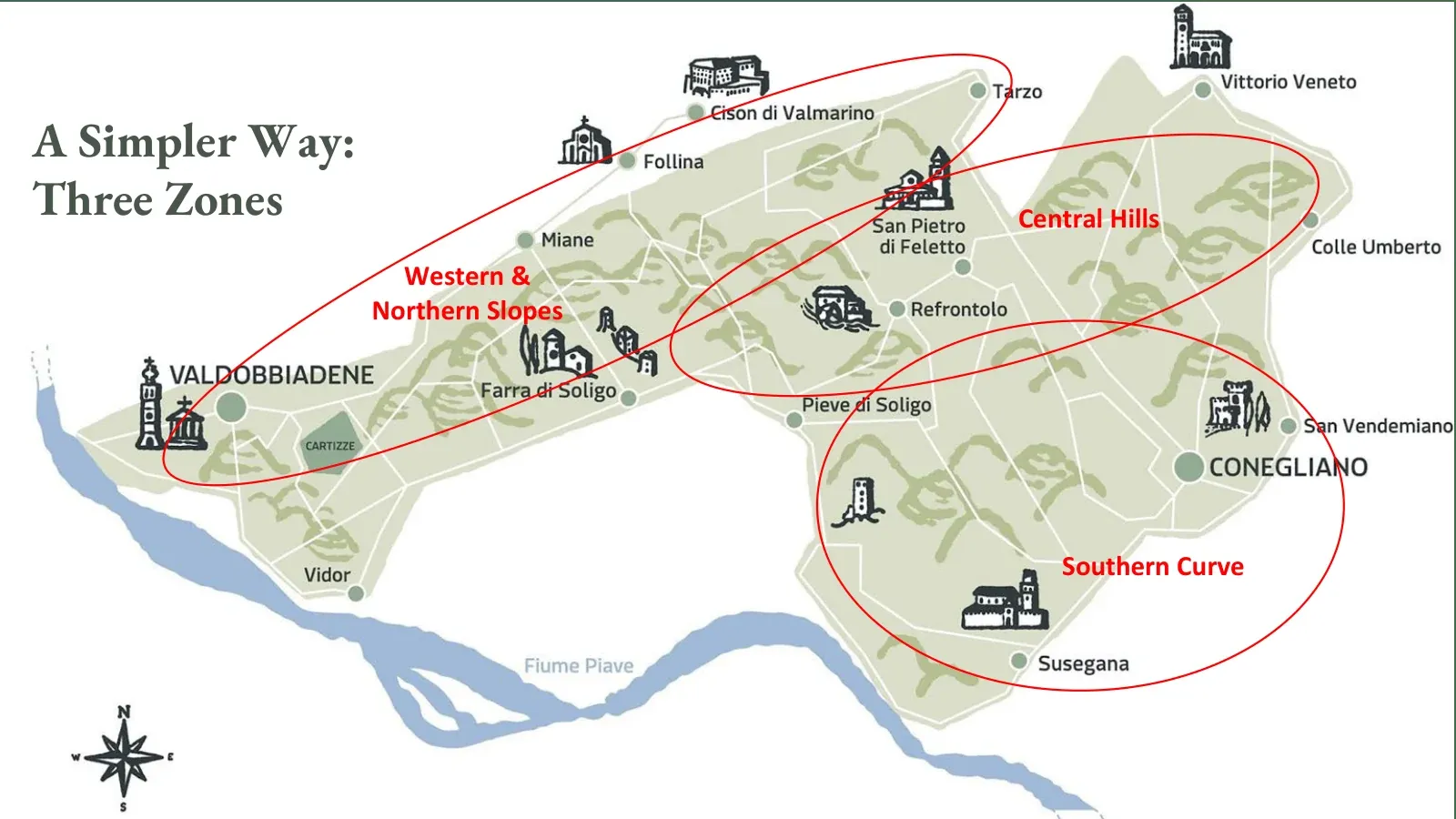 Figure: Slide 47 — the presenter’s three-zone map of the DOCG.
The southern areas were described as more humid, with richer clay soils and generally fruitier expressions. Elsewhere, differences in elevation, aspect and soil composition create other growing conditions. The point was not that every wine from a particular slope tastes alike, but that the DOCG contains meaningful differences in terroir rather than one uniform landscape.
This was one of the most interesting aspects of the tasting: moving beyond the general idea of Prosecco Superiore to consider how individual sites might produce recognizable differences in the glass.
What actually reached the glass
Winemaking remains an important part of this picture. The tank-based Martinotti/Charmat method, widely associated with Prosecco, was discussed as a process that can encourage a relatively homogeneous style. But it does not necessarily erase differences between sites.
Choices made before secondary fermentation also matter. Shorter or longer primary fermentations, yeast selection, and extended lees contact can all influence the base wine and the finished result. The seminar included examples of extended lees ageing in tank, traditional-method bottle fermentation, and Sui Lieviti, a bottle-refermented style left with its yeasts 2.
For example, Tenuta degli Ultimi’s 2019 Niente was presented with more than two years of lees ageing in tank, while Bellenda’s 2022 Sei Uno used the traditional method. These are quite different approaches to producing sparkling wine from the same broader region.
Across the tasting, I found recognizable differences in aromas, texture and mouthfeel. A single tasting cannot isolate terroir from producer decisions or winemaking techniques, but the differences were noticeable enough to make the growing emphasis on geographical origin compelling.
My main takeaway was the increasing specificity of Prosecco: from a familiar sparkling wine style, to a denomination, a named area, and finally an individual site or parcel. It’ll be interesting to see if the region continues leaning into this differentiating point a decade from now.
Notes from the Conegliano Valdobbiadene Prosecco Superiore DOCG Discussion and Tasting at Portale, New York, September 2026. Regional figures and production details are drawn from the seminar and the official Prosecco DOC and Conegliano Valdobbiadene DOCG consortia; interpretations are my own.
Footnotes
Questions or corrections?
I welcome thoughtful questions and corrections. Email [email protected].