
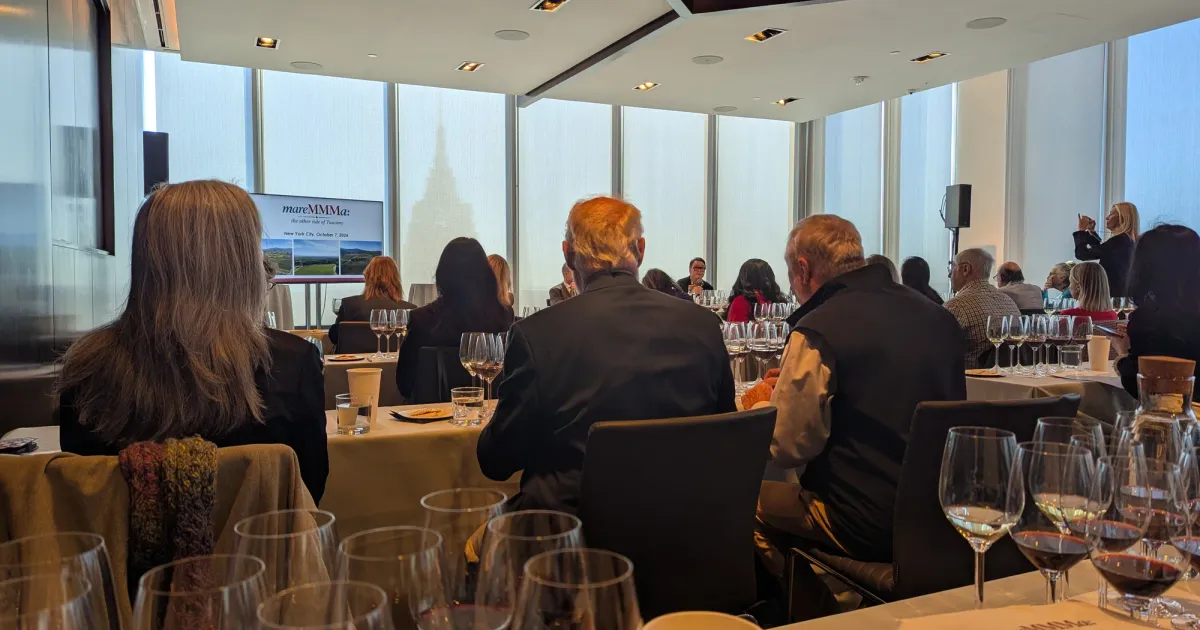
mareMMMa: the other side of Tuscany
Notes from an October 2026 guided seminar in New York with Bruce Sanderson, Senior Editor at Wine Spectator.
The three Ms in mareMMMa bring together Maremma Toscana, Morellino di Scansano, and Montecucco. At the October seminar in NYC led by Bruce Sanderson, I learnt about the tradition these winemakers want to continue building.
A broader grape mix
Maremma Toscana covers Grosseto province, a diverse territory with a coastal influence and room for international varieties. Sangiovese, Vermentino, Cabernet Sauvignon, and Merlot were central to the discussion; Ciliegiolo was a less common local presence.
Sangiovese plantings have grown, but its share of vineyard area has fallen. Vermentino is rising fastest.1 Its versatility stood out: both crisp and fresh, fuller and riper, even sweet versions, with an accessible price point.
The winemaking examples helped explain that range. Mazzei’s Belguardo Vermentino 2023 was described as combining a portion aged on its lees in stainless steel with another kept on skins in amphora. The discussion moved from fresh whites for an aperitivo to fuller styles for richer food, giving Vermentino more scope than a single summer-wine identity.
Sangiovese, in different places
Morellino di Scansano was presented as “Sangiovese by the sea.” The comparison with Chianti was a reminder that the same grape behaves differently in different places. Here, the coastal setting matters.
The speakers pointed to dry, windy days and cool nights. The tasting also showed variety within Morellino: the notes ranged from savory and mouthwatering to rounder and softer, with blending and aging choices contributing to the differences. A coastal identity still leaves room for individual producers’ styles.
Montecucco brought a different emphasis: small family wineries and wines often made entirely from Sangiovese. The seminar described producers commonly choosing 100% Sangiovese for the DOCG, beyond its 90% minimum.
On the slopes of Monte Amiata, altitude was presented as another influence on ripening, with marked differences between daytime and nighttime temperatures. The discussion also highlighted research into local Sangiovese clones, adding a practical dimension to the idea of building a regional identity.
Adapting vineyards, reaching drinkers
The speakers framed climate change as something growers could adapt to through vineyard choices: lower planting density, more canopy to shade fruit, higher sites, and different exposures. That still means changing how vineyards are managed and replanted.
That longer timescale also came up in the discussion of trends. Replanting is a commitment that can take more than a decade to bear out; the speakers cautioned against chasing demand that may change much sooner. Continuing a tradition involves adapting the vineyard while deciding which parts of its identity to carry forward.
The market discussion covered lower-alcohol and no-alcohol wines, alongside more intentional drinking. The point I took away was the need to understand what draws someone to wine: authenticity, a story, and a connection to place. These three regions offered different ways for people to appreciate that, at a lower price point than some other more famous areas.
Notes from the mareMMMa guided seminar in New York. Figures and industry observations reflect material presented at the event; interpretations are my own.
Footnotes
-
Figures presented at the seminar put Sangiovese’s share of vineyard area at 57% falling to 40%, while Vermentino rose from 2% to 12% over the period discussed. Maremma Toscana’s consortium was founded in 2014. ↩
Questions or corrections?
I welcome thoughtful questions and corrections. Email contact [at] linlib [dot] com.